Wolf Oven Repair
Wolf Self-Clean Lockouts in Bellevue: The Order to Check Things
A door that is still latched after self-clean is usually the control doing its job, not a breakage. Here is how to tell a normal cool-down from a latch that has failed, and where to stop.
Written by Imogen Fairhurst
Bench speciality: ovens and calibration · Years at it: 12
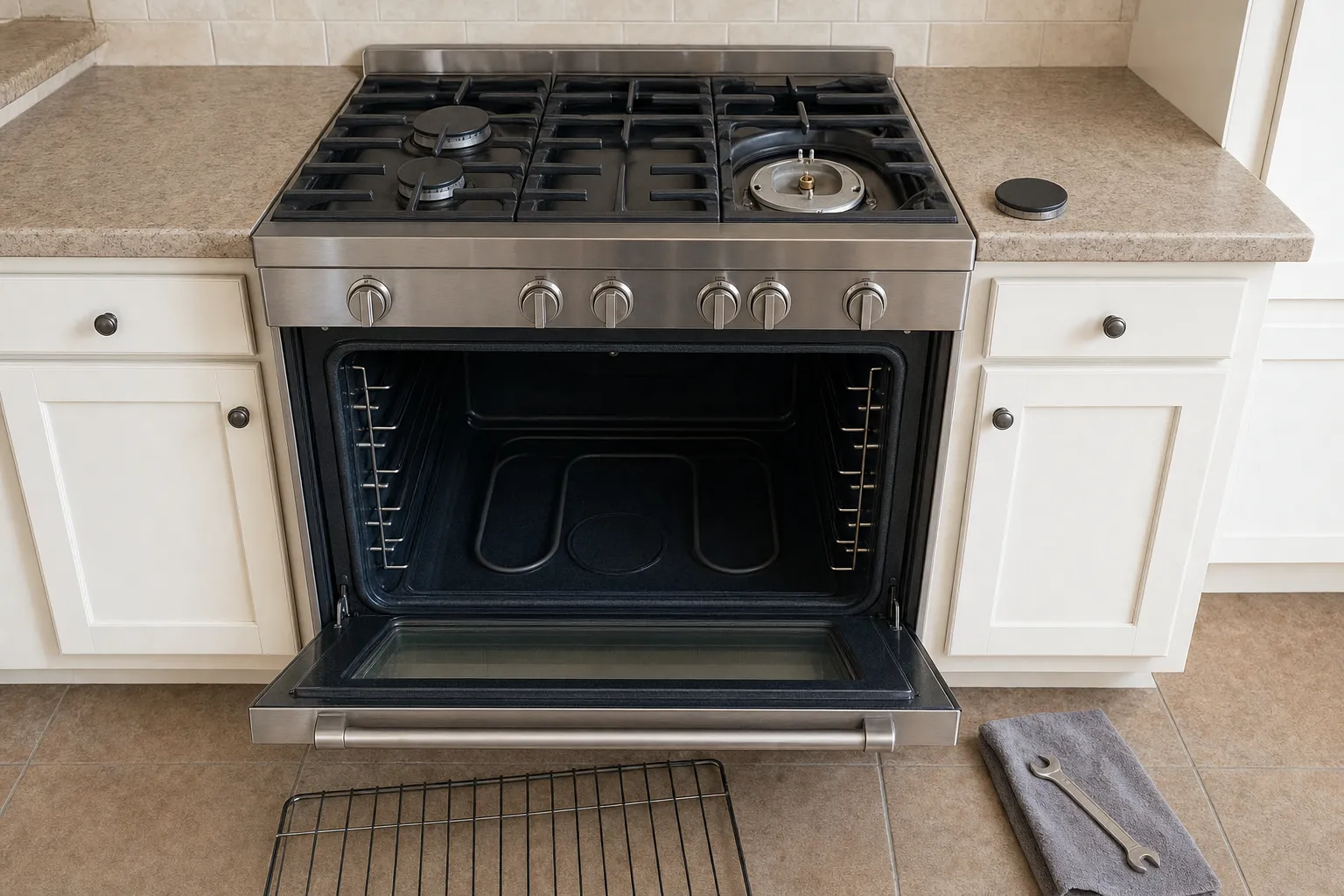
The self-clean cycle ended, the kitchen has stopped smelling of it, and the door will not open. Almost every Bellevue call that starts this way turns out to be one of three things, and only one of them needs anybody to come out.
What matters first is separating the two situations that look identical from the front: an appliance that is still holding the door shut on purpose, and an appliance that has stopped responding altogether. They are not the same problem and they do not carry the same urgency.
Before you call it a fault, wait properly
The latch is not on a timer. It releases when the control sees the cavity has come down below the point it is watching for, and that point is a long way below what the cycle ran at. So the door staying shut for a good while after the cycle reports finished is the design working, not a failure.
What is worth doing in that window is watching rather than intervening. Is the display lit and showing something sensible? Is a cooling fan still running? Is there a code on the panel, and has it been there since the cycle ended or did it appear later? Those three observations decide almost everything that follows, and they cost nothing.
In a Downtown Bellevue tower kitchen the appliance is usually built into a tight run of cabinetry with very little air behind it, and everything about cooling down takes longer than it does in a house with a wide utility wall. That is worth knowing before deciding the appliance has failed. Waiting stops being the answer when the panel has gone dark, when a code will not clear, or when the cavity is plainly cold to the touch at the glass and the latch has still not let go.
Locked, or locked and dead? They are different faults
A latch that will not release on an otherwise healthy appliance is a mechanical or a control problem, and it is repairable in place. An appliance with no display, no fan and no response is an electrical problem, and the latch is simply where you noticed it.
The useful test is one controlled power interruption at the breaker — not as a repair, but as a question. If everything comes back and the door releases, you have learned that the control locked up rather than that anything broke. If nothing comes back at all, something upstream has opened and the latch is a symptom.
One of the things that can open is a thermal fuse. It exists to cut power when the cavity gets hotter than it should, and when it acts it has done exactly what it is for. It is a one-shot device: it does not reset and it is not meant to. That is also the reason a breaker that trips again on the next attempt should be left alone rather than pushed back a third time. Repeatedly re-energising something that has just protected itself is not a plan, it is a habit that turns a part into a repair.
What the latch is and how it fails
Behind the trim there is a small motor that drives the latch across, and a switch that reports back where the latch actually is. The control will not open a door it has not been told is free, and it will not begin a cycle on a door it has not been told is captured. Everything the appliance does about that door depends on believing the switch.
So there are two quite different failures with one appearance. The latch may never have moved — a stalled motor, a jammed travel, debris in the path after a hot cycle. Or the latch may have moved perfectly well and the switch failed to report it, in which case the mechanism is fine and the control simply has not been convinced.
Both live inside a hot, high-current assembly behind a panel that is not meant to come off in a working kitchen. This is where a homeowner should stop. From here on it is a job for a technician with the oven cold and the power off at the breaker.
Codes that return after a power cycle
A code is a description of what the control observed. It is not a diagnosis and it does not name a part, which is why two appliances showing the same code can need two completely different repairs.
What separates them is behaviour. A code that clears on a power cycle and does not come back was a one-off event the control caught. A code that reappears within seconds is a live condition being re-detected, and that is a fault rather than a glitch.
Write it down before doing anything else. Clearing a code destroys the most specific piece of evidence in the whole job, and reconstructing it afterwards means reproducing the failure deliberately.
Once the door opens, check these
The cycle is the hardest thing the appliance ever does to itself, so anything already marginal tends to give up during it. It is common for the door to release normally and for something else to be wrong afterwards.
Bake and broil elements are the usual casualties, followed by control relays and the door seal, which can harden and lose its grip after a very hot run. Give the appliance one ordinary bake at a moderate setting before trusting it with anything that matters.
Ash and fine pale residue in the cavity are normal and simply wipe out. A scorched smell that lingers, or discolouration around the trim rather than inside the cavity, is not.
The manual alternative
The feature works and there is nothing wrong with using it. It is also, honestly, the most punishing hour an appliance goes through, and it finds every component that was close to the end of its life. That is not an argument against the cycle; it is an argument about timing.
Running it the day before something important is the one habit worth breaking. Bridle Trails kitchens tend to be the busiest ones we see, and the week before a holiday is the worst possible time to discover a tired element.
A soak and a hand clean does the same job with none of the thermal stress, and on an appliance with some years on it that is a reasonable default with the cycle kept for occasional use.
When to stop and call
Stop immediately for a burning-electrical smell, for a breaker that trips a second time, or for a door that is still captured long after the glass has gone cold and the panel has stopped reporting anything unusual.
Do not force it. The mechanism is not designed to be overridden by hand, and the damage from trying lands on the latch assembly and the door itself, which turns a small job into a large one.
What a visit establishes is straightforward: whether the fuse still has continuity, whether the latch motor moves when it is commanded to, and what the control is actually asking for. That answers locked-or-dead in the first few minutes. The $89 visit pays for the trip and all of that testing, and the same $89 comes off the repair if you decide to go ahead. We are in Somerset, Crossroads, Downtown Bellevue and Bridle Trails most weeks.
Common follow-ups
Is self-clean bad for the oven?
It is not damaging in itself — the feature is designed in and the appliance is built to survive it. What it does is run the cavity far hotter than any cooking ever will, and that finds components which were already near the end of their working life. The cycle rarely causes a failure so much as it brings a pending one forward.
Should I run self-clean before a holiday?
No. If something marginal is going to give up, this is the hour it will happen, and you will be looking for a technician on the worst possible week. Run it well ahead of anything that depends on the appliance, then bake something ordinary afterwards to confirm it came through fine.
How long should the door stay locked after a self-clean cycle?
Longer than most people expect, and it varies by model, so check the use and care guide for yours rather than a general figure. The release is triggered by temperature, not by a clock: the control holds the door until the cavity has come down below its threshold. If the glass is cold to the touch and the latch has still not let go, that is the point at which it is worth a call.