Wolf Oven Repair
Wolf Oven Bakes Cold Even Though the Display Says 350
If your Wolf oven reaches temperature on the display but bakes like an oven thirty degrees cooler, the fault is almost always calibration, the sensor or the door seal — not the control board.
Written by Imogen Fairhurst
Bench speciality: ovens and calibration · Years at it: 12
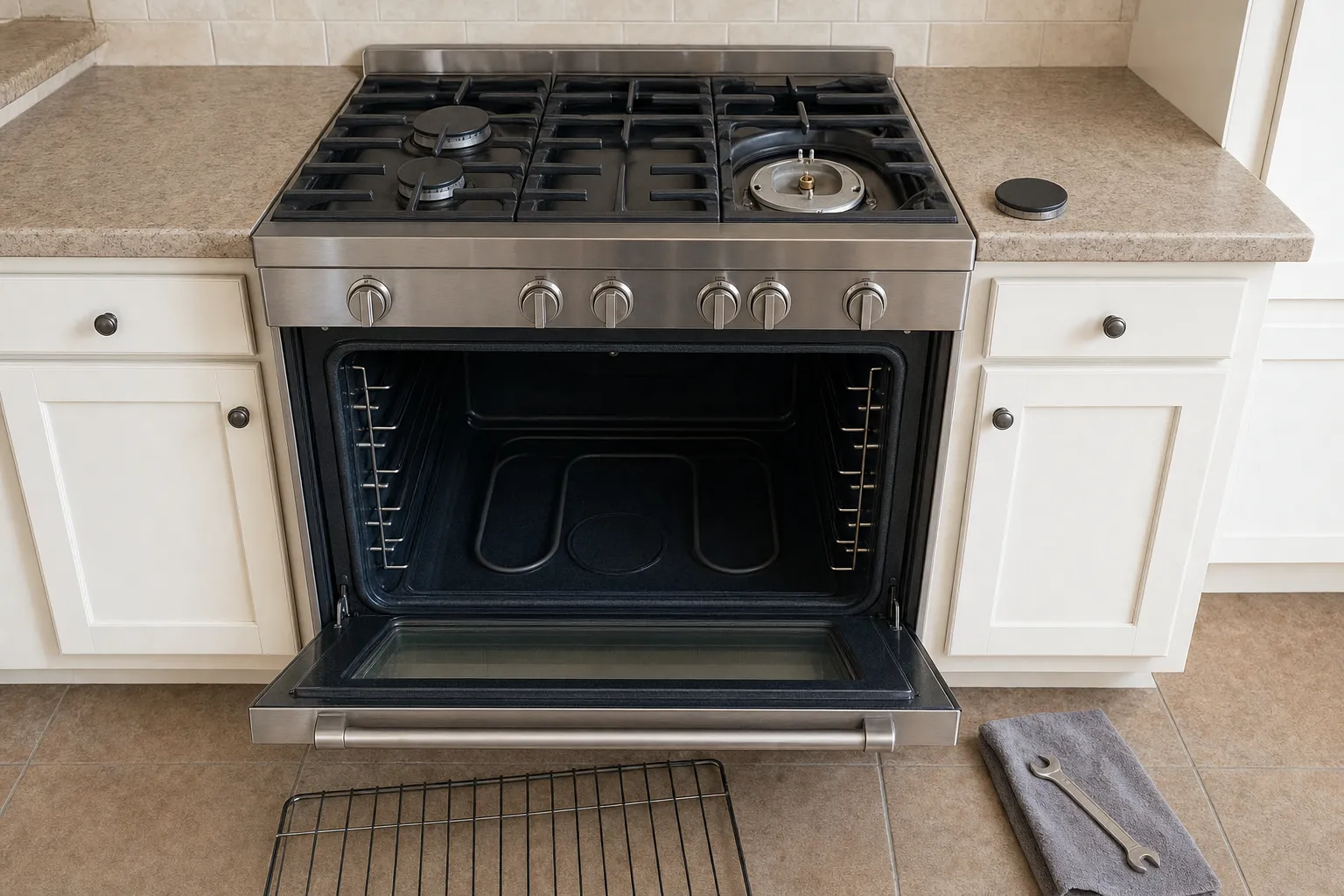
Almost every “my Wolf oven is not accurate” call in Bellevue starts the same way: the display climbs to 350, the preheat tone sounds, and then the baking says otherwise. Cakes stay pale and sink in the middle. Bread does not spring. A roast that used to take fifty minutes now needs seventy. The display is not lying deliberately — it is faithfully reporting what its sensor tells it, and the useful question is why the sensor and the cavity disagree.
The good news is that a steady, repeatable offset is one of the more diagnosable faults in a built-in oven, and the expensive component everyone worries about is rarely the one at fault.
Prove the offset before you chase it
Do not trust an oven thermometer hung off a rack for five minutes. Get a decent independent probe thermometer, put it in the centre of the middle rack, and give the oven a full thirty minutes at 350 after the preheat tone. Ovens overshoot and settle, and a reading taken at the tone tells you almost nothing.
Write down what the probe says at thirty, forty and fifty minutes. What you are looking for is the pattern, not a single number:
- A steady offset — the probe reads 320 every time you check it. That is a calibration or sensor problem, and it is the most common of these three by a wide margin.
- A wide swing — the probe wanders between 310 and 380 across the bake. That points at the sensor, the element cycling, or heat escaping faster than the thermostat expects.
- A slow drift downward — the oven starts right and gets progressively colder, or takes far longer to recover after the door opens. That is usually a seal or a door alignment issue.
Those three patterns lead to three different repairs. Skipping this step is how people end up buying parts they did not need.
Calibration, and who does it
On a Wolf electric oven, calibration is not an owner setting. Wolf’s own guidance is that adjusting the oven against its setpoint is possible but seldom needed, and that it belongs to a service technician rather than to a menu the owner opens.
What is yours to do comes first anyway. Wolf lists the checks: the right mode, racks and rack guides seated properly, a gasket that is not flattened or torn, a door that closes fully, and nothing on the oven floor or in the cavity blocking the air.
Two cautions about the measuring. Use a known-good probe, because a cheap dial thermometer can be well out on its own. And an oven that was accurate for years and now reads well off is telling you something has changed; a correction that only hides a failing sensor has to be redone a few months later.
If the gap is steady and the checks above are clean, that is the point to book a diagnosis rather than to keep adjusting the dial.
The oven temperature sensor
The sensor is a thin probe that reaches into the cavity, and it is a resistance device. What it measures is its own resistance, which rises and falls in a known curve as the cavity heats, and the board turns that figure into the number on your display. When a sensor drifts, the board reads it faithfully and heats to the wrong point in complete good faith.
Three things point at the sensor rather than anything else. The offset is steady and has grown over months. The oven behaves differently in bake and convection, because different modes weight the sensor reading differently. Or the sensor probe has been knocked — it takes very little to bend one against a rack or a roasting pan, and a sensor touching the cavity wall reads the wall, not the air.
A sensor costs a fraction of a control board and is a straightforward replacement for a technician. It is the single most common real fix for a Wolf oven that bakes cold, and it is the reason a board should never be the first suspicion.
The door, the seal and the things nobody checks
Heat leaving the cavity is as much a temperature fault as heat never arriving. Take sixty seconds on this before assuming electronics:
- Run a hand around the closed door while the oven is hot. Warmth on your palm at the edges is normal; a distinct moving stream of hot air is not.
- Check the gasket all the way round for flattened, hardened or torn sections, particularly at the lower corners where it takes the most abuse.
- Look at the door gap with the oven cold. A door that sits proud on one side has a sprung hinge, and a sprung hinge holds the seal open at the top.
- Try the paper test. Close a sheet of paper in the door at several points around the perimeter. It should drag noticeably when you pull it. Anywhere it slides free is a leak.
Double ovens deserve one extra check: confirm which cavity is actually misbehaving. More than once we have arrived to find a perfectly good lower oven blamed for an upper one that has been running cold for a year.
When to stop and call
The measuring and the look at the door are yours. Leave the gasket in place even when it looks tired: Wolf warns that rubbing or moving it can spoil the seal, so a replacement is part of the door repair rather than a weekend job.
Call someone when the oven throws a fault code and locks itself out, when the offset is large or still growing, when the swing is wide enough that the element is audibly cycling every couple of minutes, or when the door will not close square. Those are sensor, hinge, element or wiring faults, and all of them are far cheaper to fix correctly than to fix twice.
Bring the model and serial number to the call. On a Wolf oven those two numbers tell us which sensor, which door assembly and which control generation you have, so the likely part can be looked up before the visit instead of after it.
Common follow-ups
Should I just turn the oven up thirty degrees and live with it?
You can as a stopgap for baking, but it hides a fault that usually gets worse, and it does nothing for recipes that rely on the oven holding a set point rather than reaching it. It also will not help roasting, where the swing matters more than the average.
How accurate should a Wolf oven actually be?
A healthy oven cycles a little either side of its set point rather than sitting dead flat — that is normal thermostatic behaviour. What is not normal is an average that sits well away from the setting bake after bake, or a swing wide enough that the element is visibly on for most of the bake.
Does the self-clean cycle cause this?
It can contribute. Self-clean runs the cavity extremely hot, and that is the cycle where a marginal sensor, a tired door seal or an ageing thermal fuse most often gives up. A calibration that drifts noticeably right after a clean cycle is a common pattern.
Is a control board ever the answer?
Occasionally, but it is the last thing to suspect, not the first. Boards are the most expensive part in the oven and the least likely cause of a steady offset. Anyone who quotes a board before putting a probe in the cavity is guessing with your money.